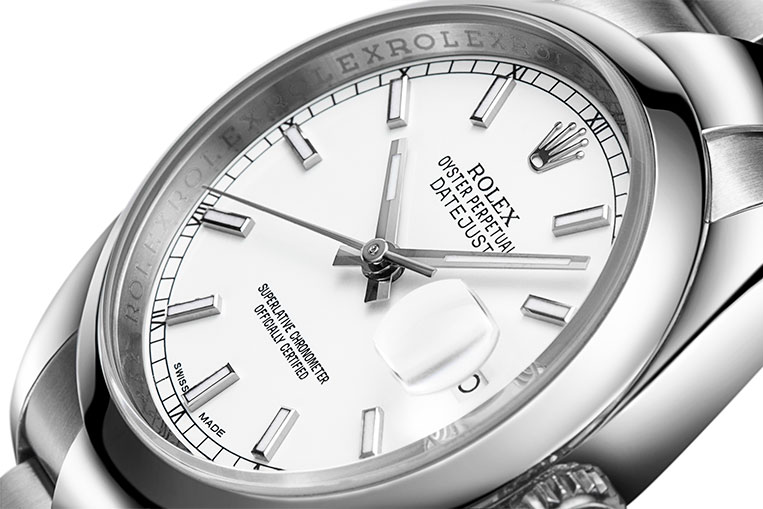
The Datejust is the most-bought Rolex in Britain and the one people agonise over longest, because it is the only model in the catalogue where you genuinely have to choose a size. We hold 629 Datejusts from £3,550, and the single question that decides which one a customer walks out with is 36 or 41. Here is how to answer it without guessing.
The two sizes, and what actually changes
The Datejust 36 (references 126200, 126234, 116200, 116234 and the earlier 16200 family) has been the default Rolex since 1945. The Datejust 41 (126300, 126333, 126334 and the transitional Datejust II 116300) arrived properly in 2016 and now outsells it new.
The 5mm on paper understates the difference on the wrist. The 41 carries a wider bezel, a thicker case band and a 21mm lug width against the 36's 20mm, so it reads considerably larger than the number suggests. The 36 sits flatter and tucks under a cuff; the 41 does not.
Match the case to your wrist, not to fashion
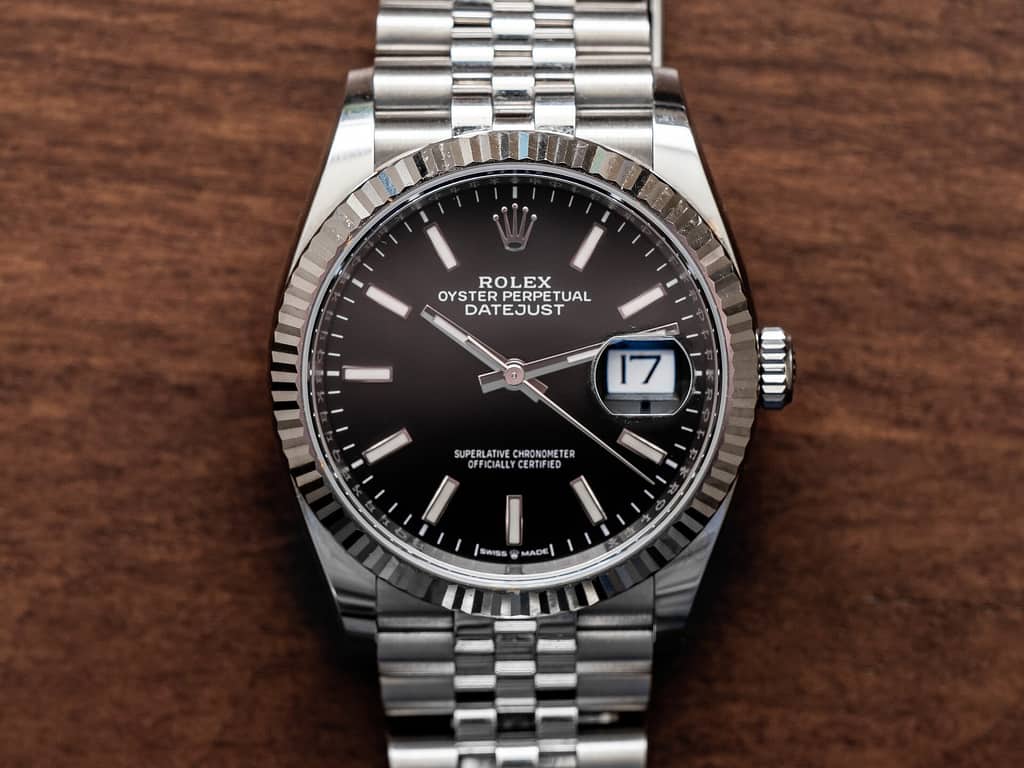
The reliable rule is lug-to-lug, not diameter. The Datejust 36 measures roughly 44mm across the lugs, the 41 roughly 50mm. If your wrist is under 17cm in circumference, the 41's lugs will usually overhang the flat of the wrist and the watch will rock. Between 17 and 18cm, both work and it becomes taste. Above 18cm, the 41 will look properly proportioned and the 36 will read as a deliberately classic choice rather than an undersized one.
Measure with a tailor's tape before you shop. It is a thirty-second job that saves a five-figure mistake.
Bracelet and bezel change the size more than you expect
A fluted bezel in white or yellow gold catches light and visually widens the case; a smooth domed bezel narrows it. A Jubilee bracelet, with its five-link construction, softens the whole watch and flatters a smaller wrist. The three-link Oyster is broader and squarer and pushes the watch a size up.
The practical consequence: a 41mm Datejust on a smooth bezel and Oyster bracelet can wear more restrained than a 36mm on a fluted bezel and Jubilee. Do not judge from the specification sheet alone.
What each size costs pre-owned in the UK
Across our stock the Datejust family runs from £3,550 to £31,995, and size is not the main driver — metal is. A steel 36 on an Oyster bracelet is the entry point. Add a white-gold fluted bezel and a Jubilee and you move up a band. Two-tone Rolesor in steel and yellow gold sits above that, and solid gold above everything.
The 41 generally commands a modest premium over an equivalent 36 of the same generation, largely because the 41 references are newer and therefore younger watches. Compare like for like: a 2019 126300 against a 2019 126200, not against a 2005 116200.
The case for the 36
It is the original proportion, it suits every wrist, it is the one that looks correct in fifty-year-old photographs and will look correct in fifty more. It is also the size in which the widest range of dials and vintage references exist, so if you want a specific dial — a linen finish, a tapestry, a wideboy — the 36 is where you will find it.
The case for the 41
It uses the newer calibre 3235 movement with a 70-hour power reserve against the 3135's 48, it has a noticeably better bracelet with the Easylink 5mm comfort extension, and it reads as a contemporary watch rather than a heritage one. If this is your only watch and you want it to feel modern, the 41 is the honest answer.
Browse the collection
Browse every pre-owned Rolex Datejust we hold — 629 watches from £3,550, each independently authenticated and supplied with our 24-month warranty. Smaller sizes live in the Lady-Datejust collection.
Frequently Asked Questions
It is wearable but close to the limit. Try the 36 first; most people at 17cm end up preferring it.
Neither is a poor performer. Steel Datejusts of both sizes with box and papers are the most liquid, which matters more than size.
The 36 is unisex and always has been. Below that, the 31mm and 28mm Lady-Datejust references are the natural step down.