The Day-Date is the only Rolex that has never been made in steel. Launched in 1956, it spells the day of the week in full at twelve o'clock, wears a President bracelet, and is cased exclusively in gold or platinum. Our 84 examples run from £10,000 to £98,945 — and understanding that spread is most of the buying decision.
Why it is called the President
Rolex named the bracelet, not the watch. The semi-circular three-piece link bracelet introduced with the Day-Date in 1956 was called the President, and the name migrated to the watch because enough heads of state wore one. Lyndon Johnson is the usual citation; Eisenhower actually wore a Datejust.
The distinction matters when buying: a Day-Date on a leather strap or an Oyster bracelet is still a Day-Date, but the President bracelet is what the market pays for.
The reference generations
The 1803 (1959–1977) is the vintage benchmark: 36mm, acrylic crystal, no quickset date. The 18038 / 18238 / 18338 family (1977–2000) brought sapphire, quickset and then double-quickset. The 118xxx generation (2000–2015) modernised the case and movement, and the 128xxx and 36mm-and-40mm 228xxx references (2015–) use the calibre 3255 with its 70-hour reserve.
The Day-Date 40 (228xxx) is a genuinely different watch from the 36mm — broader, flatter, considerably more present.
Dials are where the money is
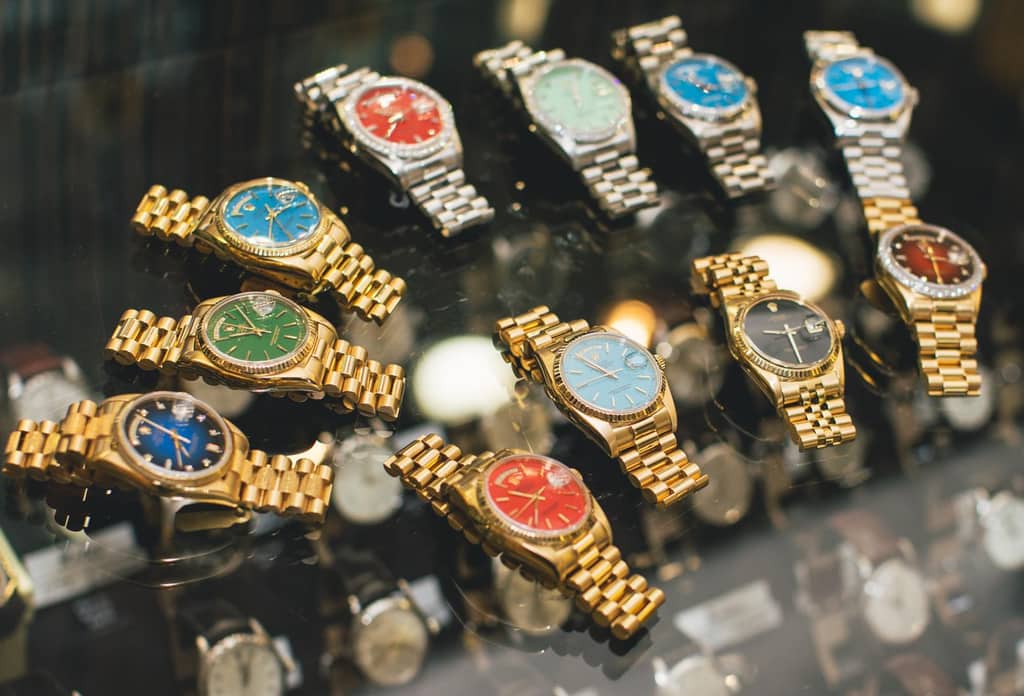
The Day-Date has carried the most extravagant dials Rolex has ever made: lapis lazuli, malachite, onyx, meteorite, wood, and the lacquered "Stella" dials in coral, turquoise, oxblood and burgundy that 1970s Rolex produced for Middle Eastern markets and that now command extraordinary sums.
A stone or Stella dial can multiply the value of an otherwise ordinary reference several times over. Verify it rigorously — repainted Stella dials are a known problem.
Metals and what they do to price
Yellow gold is the classic and, counter-intuitively, usually the most affordable because most were made. White gold is the discreet choice — from three feet away it reads as steel, which is either the whole appeal or entirely the point of failure depending on your temperament. Everose, Rolex's patented rose gold alloy with a platinum trace to stop it fading, is the modern favourite. Platinum, always with an ice-blue dial in modern references, sits at the top.
Our range tops out at £98,945, and gem-set examples occupy that upper end.
What to check
Weigh it, figuratively. A solid-gold President bracelet is heavy and its links should be tight; stretch is common on older examples and expensive to correct because the links are gold.
Check the day wheel language — Rolex has produced the Day-Date in dozens of languages, and an unusual one can add or subtract value depending on the market. Check the dial is correct for the reference, and check gem settings are factory rather than aftermarket.
Who it is for
The Day-Date is not a subtle watch and it is not trying to be. It is the Rolex you buy when you have already bought the sensible ones, or when you want a single significant piece and steel is not the point.
Browse the collection
Browse pre-owned Rolex Day-Date models — 84 watches from £10,000, in yellow gold, white gold, Everose and platinum.
Frequently Asked Questions
No. Rolex has never made one, and anything presented as one is not a Day-Date.
The 36 is the classic proportion; the 40 is the modern one. Both are current. Try both.
They reduce value substantially and can affect insurability. Factory-set stones are documented and priced accordingly.