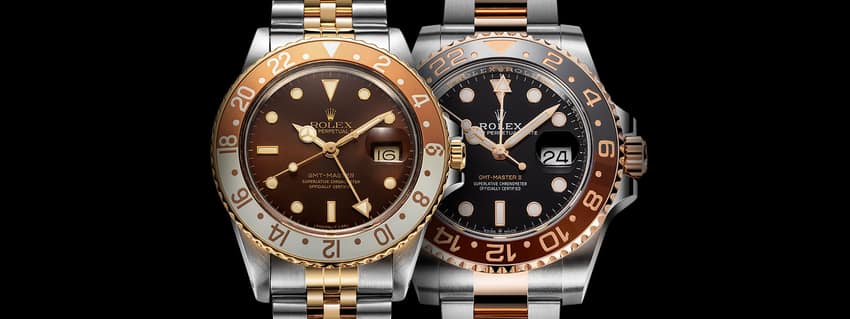
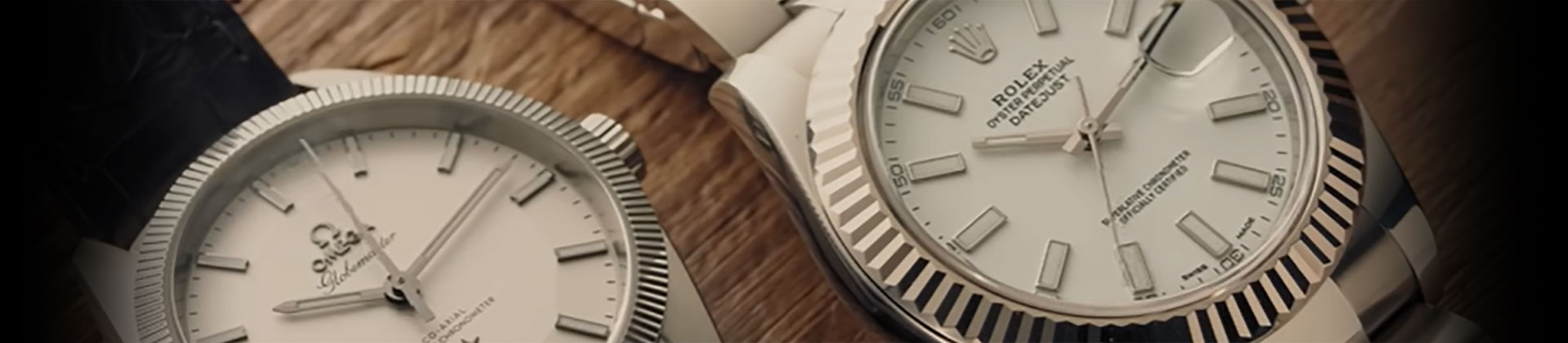
The bracelet is half the watch. It is most of the metal, most of the weight and all of the contact with your wrist, and on a Datejust or a GMT-Master II you get to choose. The choice between the three-link Oyster and the five-link Jubilee changes the character of the watch more than any dial colour.
The Oyster: three links, built to work
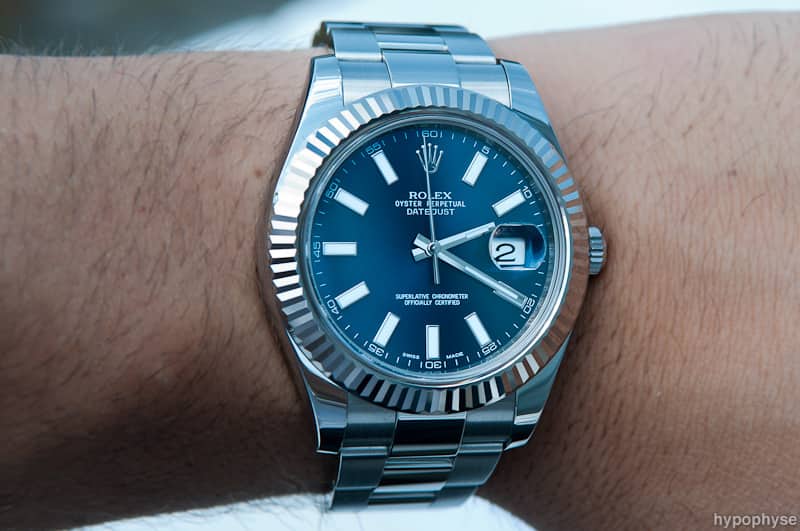
Introduced in the 1930s and refined ever since, the Oyster bracelet is three flat links — a wide centre link between two narrower outer links. It is the bracelet on every Submariner, every Sea-Dweller, every Daytona and most Explorers.
It is stiffer than a Jubilee, more resistant to stretch, easier to clean, and it reads as purposeful. On a sports watch it is the only correct answer.
The Jubilee: five links, made for the Datejust
Rolex designed the Jubilee in 1945 specifically for the Datejust's fortieth-anniversary launch — hence the name. Five links, with three narrow polished centre rows between two brushed outers, give it far more articulation and a dressier, jewellery-like presence.
It wraps a wrist better than anything else Rolex makes. If comfort is your priority, this is the bracelet.
Durability and stretch
Older Jubilees, particularly hollow-link examples from before the 1990s, are notorious for stretch: the pins and link holes wear, and the bracelet develops a sag you can hear. Modern solid-link Jubilees are dramatically better but still articulate more, and more articulation means more wear points.
The Oyster, with fewer and larger links, simply has less to wear out. On a watch you intend to wear hard, that matters.
Formality
The Jubilee's polished centre links catch light and dress a watch up. The Oyster's brushed surfaces play it down. A steel Datejust on an Oyster reads as a sports-adjacent everyday watch; the same Datejust on a Jubilee reads as jewellery you can dive in.
Neither is wrong. But if you own one Rolex and wear it to both a building site and a wedding, the Oyster is the more flexible of the two.
Clasps: the detail that dates a watch
Modern Oyster bracelets use the Oysterlock or Oysterclasp with Easylink, a 5mm tool-free extension that is genuinely useful on a hot day. The Glidelock on dive models extends up to 20mm in 2mm increments. Modern Jubilees use the concealed Crownclasp, which hides the buckle entirely under a folding cover.
Check the clasp code stamped inside. It should be consistent with the watch's generation; a mismatch usually means a replaced bracelet.
Changing between them
It is possible on many references — the end links must match the case and the lug width — but a genuine Rolex bracelet bought separately is expensive, often four figures. Factor that in rather than assuming you will swap later.
Aftermarket bracelets exist and we would not fit one. They damage resale and they rarely fit the case properly.
Browse the collection
Filter the Datejust collection by bracelet to compare Jubilee and Oyster examples side by side, from £3,550.
Frequently Asked Questions
The Jubilee, for most people, by a clear margin.
Yes. An original, correct bracelet in good condition with matching end links and clasp codes is worth real money.
Physically it can be done; the market does not reward it. Sports Rolexes belong on Oyster bracelets.